Tree Removal
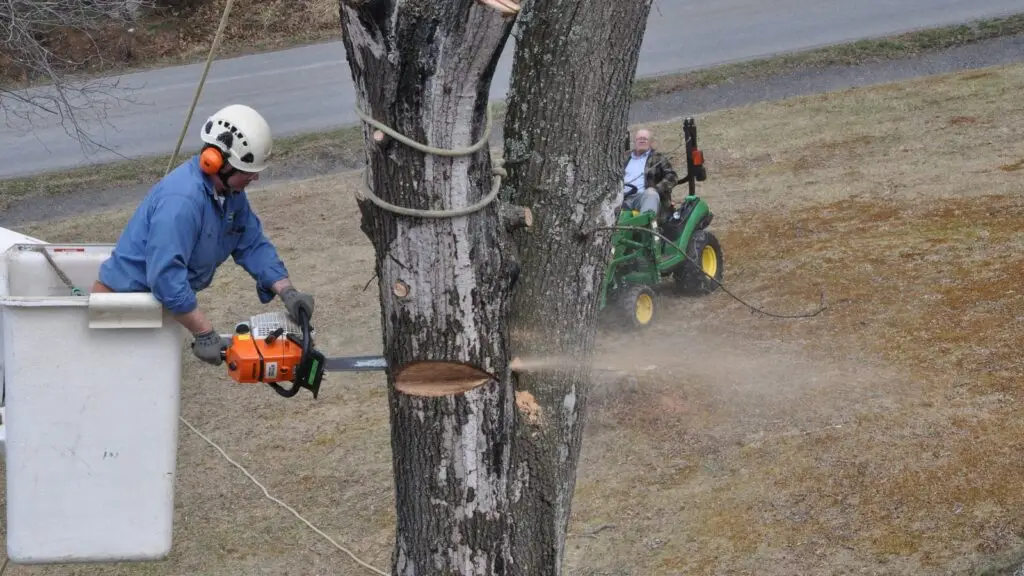
Tree removal is the safe, controlled taking down of a tree that has become a hazard, has died, or stands where you need the ground. David’s Tree Service has been removing trees around Lynch Station, Lynchburg and the surrounding counties since 1993. Licensed and insured, with the same crew doing the quoting and the cutting.
Tree removal in Lynch Station and central Virginia
Tree removal is the safe, controlled taking down of a tree that has become a hazard, has died, or stands where you need the ground. David’s Tree Service has been removing trees around Lynch Station, Lynchburg and the surrounding counties since 1993. Licensed and insured, with the same crew doing the quoting and the cutting.
Call 540-297-3454 and David will come look at it. Free estimate.
When a tree needs to come down
Not every tree does, and we’ll tell you when one doesn’t. The ones that usually do:
- It’s dead or most of the way there. A dead tree gets more dangerous every season, and it gets more expensive to take down safely once the wood goes soft.
- It’s leaning toward something that matters. A house, a driveway, a power line, a barn.
- There’s decay in the trunk. A cavity or soft spot at the base means the tree can fail without warning, in a wind you wouldn’t think twice about.
- It split at the fork. Two stems growing tight together with bark pinched between them is the single most common failure we see after an ice storm.
- It’s in the way. Building, septic, fence line, or a view of the lake.
The trees that give people trouble around here
Thirty-three years in the same counties teaches you which trees call us out.
Tulip poplar is the big one. They grow fast, they grow tall, and a mature one standing over a house is a serious piece of work to take down. When they fail they fail all at once.
Black locust is everywhere in this area and it’s brittle. It decays from the inside while still looking healthy from the road.
Leyland cypress gets planted in rows for screening and then blows over, because the roots stay shallow and the whole row catches wind like a sail.
Pines — Virginia, loblolly, white — are common on rural and lakefront lots. An exposed pine that has lost its neighbors to clearing is a candidate for uprooting in saturated ground.
Red maple and the oaks are usually sound, but they get big, and a large dead limb over a driveway is a hazard on its own.
How we take one down
- We come look at it. David walks the site, checks what’s underneath and around it, and tells you what it needs. Free, and no obligation.
- You get a price before anything starts. One number, including cleanup. If stump grinding is separate we say so then, not after.
- We set up. Drop zone cleared, rigging set where the tree can’t simply be felled whole.
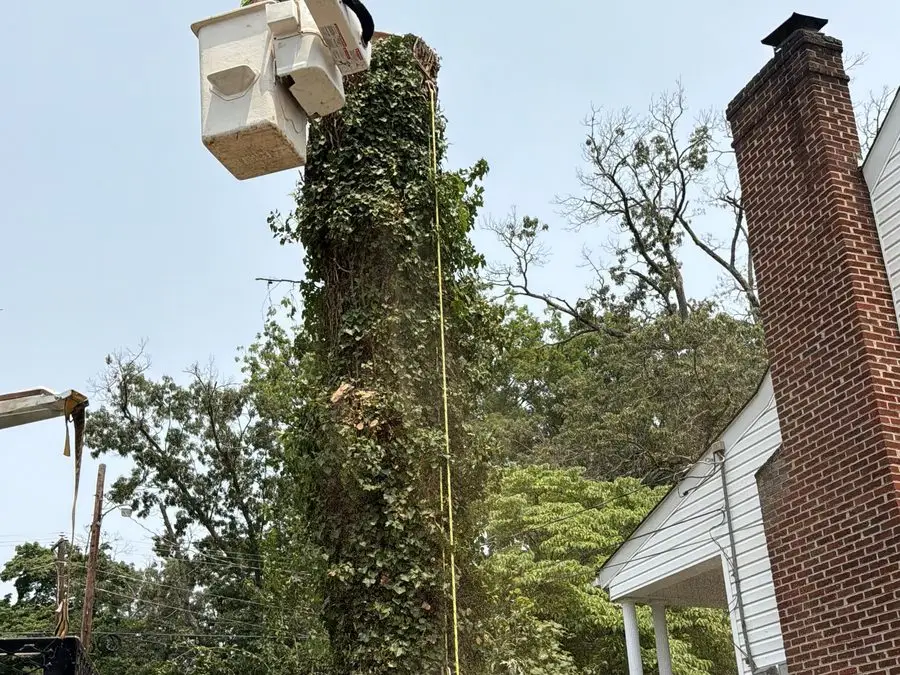
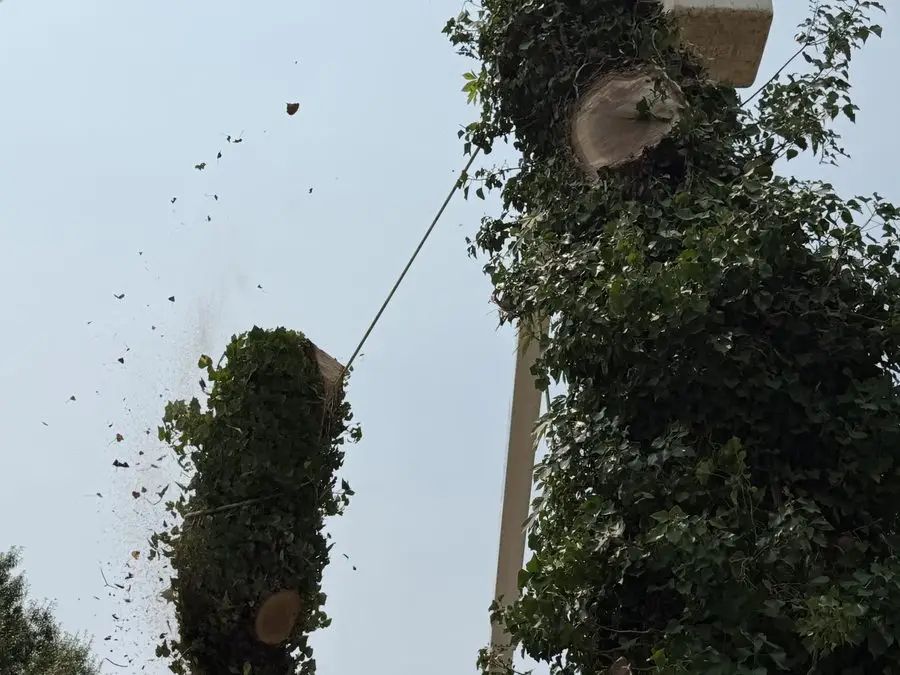
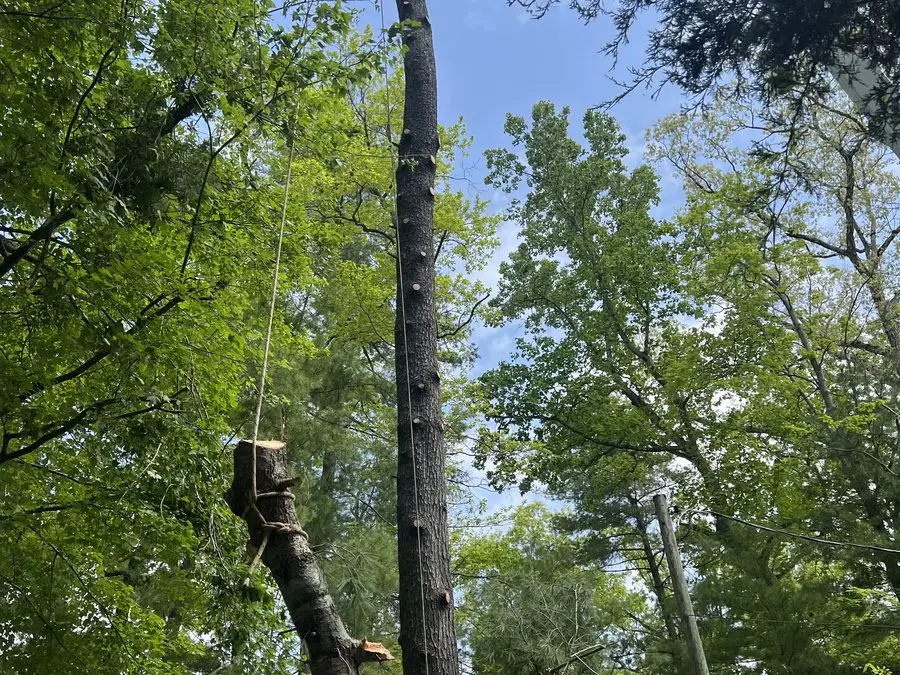
- It comes down. In an open field, felled in one piece. Near a house, dock or line, taken down in sections and lowered on ropes.
- We clean up. Brush chipped, logs cut and hauled or left stacked if you want the firewood. Yard raked.
What makes one removal cost more than another
People ask why two trees that look similar are priced differently. It comes down to a handful of things:
- Height and trunk diameter. More tree means more climbing, more rigging and more wood to handle.
- What’s underneath it. A tree in an open lawn can be dropped. A tree over a roof, a pool, a dock or a power line has to be dismantled piece by piece, and that takes hours rather than minutes.
- Whether we can get equipment to it. Steep lake lots, narrow driveways, soft ground and fenced back yards all add labor.
- Whether it needs a crane or a bucket. Tall trees in tight spots sometimes do.
- Condition. A storm-damaged tree, one hung up in another, or one partially uprooted is more dangerous and takes longer.
- What happens to the wood. Hauling everything away is different from leaving you the logs.
We price the job after looking at it, not from a chart. That’s why the estimate is free.
Frequently Asked Questions
Will you take the tree away or leave the wood?
Does removal include the stump?
Can you take down a tree next to my house?
What about a tree near a power line?
Do I need to be home?
How long does it take?
Get a free estimate
Tell us what you are looking at and we will come price it. If a tree is down right now, call our 24/7 emergency line, 540-871-8338, instead.
Call and we'll come look
If you’re not sure whether a tree needs to come down, that’s worth a phone call. We’ll tell you straight. Sometimes the answer is that it’s fine, or that trimming it solves the problem for a lot less money.